How Pitch Moisture Gradients Steer Bowler Rotation Choices Across Test Cricket Series
Written by Frankie Müller · Aug 14, 2026
How Pitch Moisture Gradients Steer Bowler Rotation Choices Across Test Cricket Series
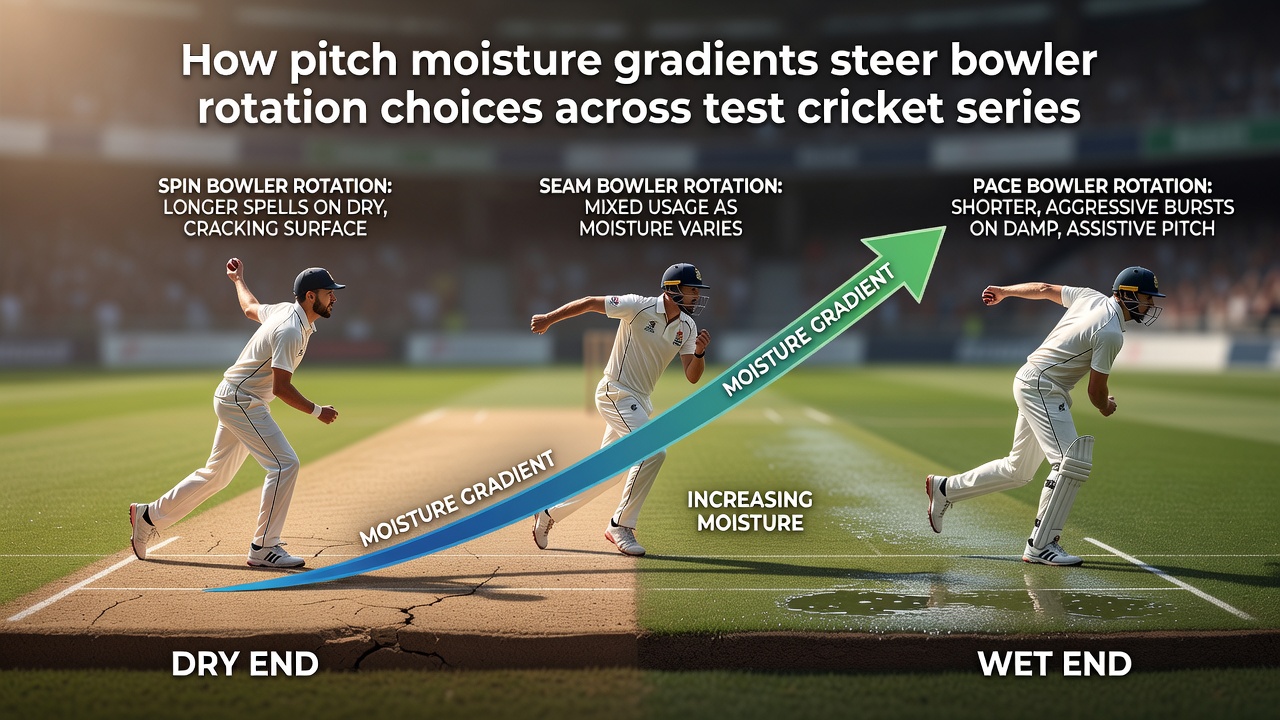
Moisture gradients across a test cricket pitch develop through a combination of preparation techniques, weather exposure, and daily wear, and these patterns directly shape how captains and coaches adjust their bowling rotations over five days. Data from international matches indicate that early-session seam movement remains stronger on surfaces retaining higher subsurface moisture, while drier top layers later in a series favor spin bowlers who exploit surface cracks and reduced pace. Observers note that teams track these shifts using handheld meters and visual assessments to decide when to rotate seamers for spinners or introduce part-time options.
Formation of Moisture Gradients During Test Matches
Pitch curators apply water selectively during preparation, yet natural evaporation and foot traffic create uneven moisture retention between the ends and the middle. Research from cricket boards shows that the batting end often loses moisture faster under sunlight exposure, whereas the bowling crease retains dampness longer due to repeated ball impacts and shade from stands. This gradient influences ball behavior because a moist subsurface helps seamers generate lateral deviation, while a drier crust reduces grip for fast bowlers and increases turn for spinners once the surface cracks widen. Teams monitor these changes session by session because a single heavy roller can temporarily redistribute water and alter swing conditions for the next hour of play.
Effects on Seamer and Spinner Effectiveness
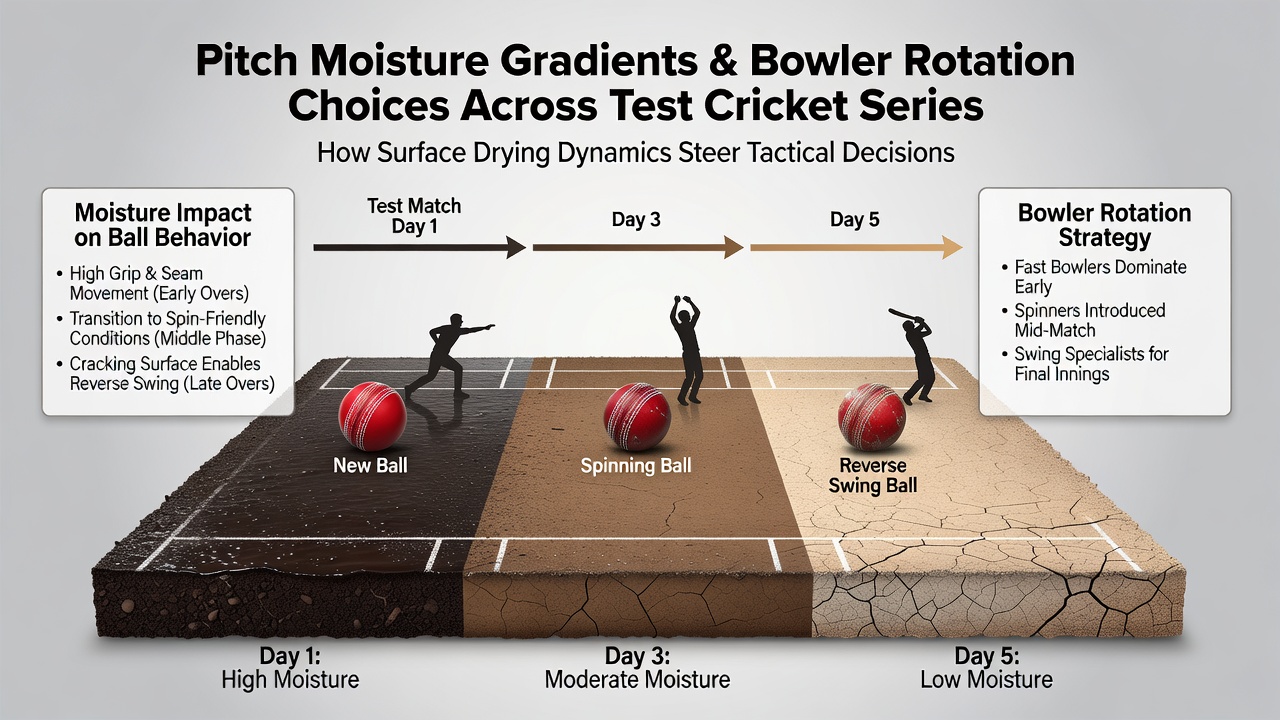
Seam bowlers gain advantage from consistent subsurface moisture that allows the ball to grip and deviate off the seam, yet as the gradient flattens over days two and three the same bowlers often lose control and concede more runs. Spinners, conversely, encounter improved purchase once top-layer moisture drops below a threshold that studies place around 8 to 10 percent, a level commonly reached by the third afternoon in most test venues. Captains therefore rotate their attacks to keep seamers fresh for periods when the gradient still supports swing, while resting them during extended dry spells that favor wrist spinners. Figures from recent series reveal that sides maintaining separate moisture logs for each end achieve more accurate timing on these changes compared with teams relying solely on visual inspection.
Rotation Patterns Observed Across Multi-Match Series
Across a five-test series the cumulative effect of repeated rolling and watering produces progressive drying that accelerates after the second match, prompting teams to increase spin options in the later fixtures. Data compiled by national performance units show that seam bowlers typically bowl 15 to 20 percent fewer overs in the final test compared with the opener when both sides play on the same strip of venues. Captains respond by introducing slower bowlers earlier on day one of later matches, conserving their quicks for the new-ball phases when any residual gradient still assists movement. One study of Australian and Indian series between 2022 and 2025 found that sides adjusting rotations within the first session based on moisture readings reduced average first-innings totals by roughly eight runs per match.
Measurement Tools and Decision Frameworks
Modern teams employ portable moisture meters and drone imagery to map gradients at multiple depths, feeding results into decision matrices that predict optimal bowling combinations hour by hour. These tools replace earlier reliance on finger tests and allow quantitative comparison between ends before each session begins. Coaches cross-reference readings with historical data from the same ground, noting that venues in drier climates exhibit steeper gradients and therefore demand more frequent rotation adjustments. The approach has become standard practice ahead of the August 2026 schedule, where several boards plan to publish anonymized moisture datasets for public analysis.
Case Examples from Recent International Contests
During the 2024 series between England and India, moisture readings at Old Trafford revealed a pronounced end-to-end difference on day three that prompted both captains to open with spin inside the first hour after lunch. Similar patterns appeared at venues in Australia during the 2023-24 Ashes, where teams shortened seam spells once subsurface readings fell below critical thresholds. Observers recorded that these data-driven rotations correlated with improved economy rates for the bowling side in each instance, although outcomes still depended on individual bowler skill and tactical field placement.
Conclusion
Moisture gradients remain a measurable variable that test teams incorporate into bowler rotation planning through systematic monitoring and historical comparison. As measurement technology advances, the precision of these decisions continues to rise, shaping how attacks are constructed across entire series rather than single matches. The practice links directly to performance metrics tracked by national boards and international competition records.