Venue Microclimates and Penalty Conversion Trends in Regional Soccer Circuits
Written by Frankie Müller · Aug 5, 2026

Venue Microclimates and Penalty Conversion Trends in Regional Soccer Circuits
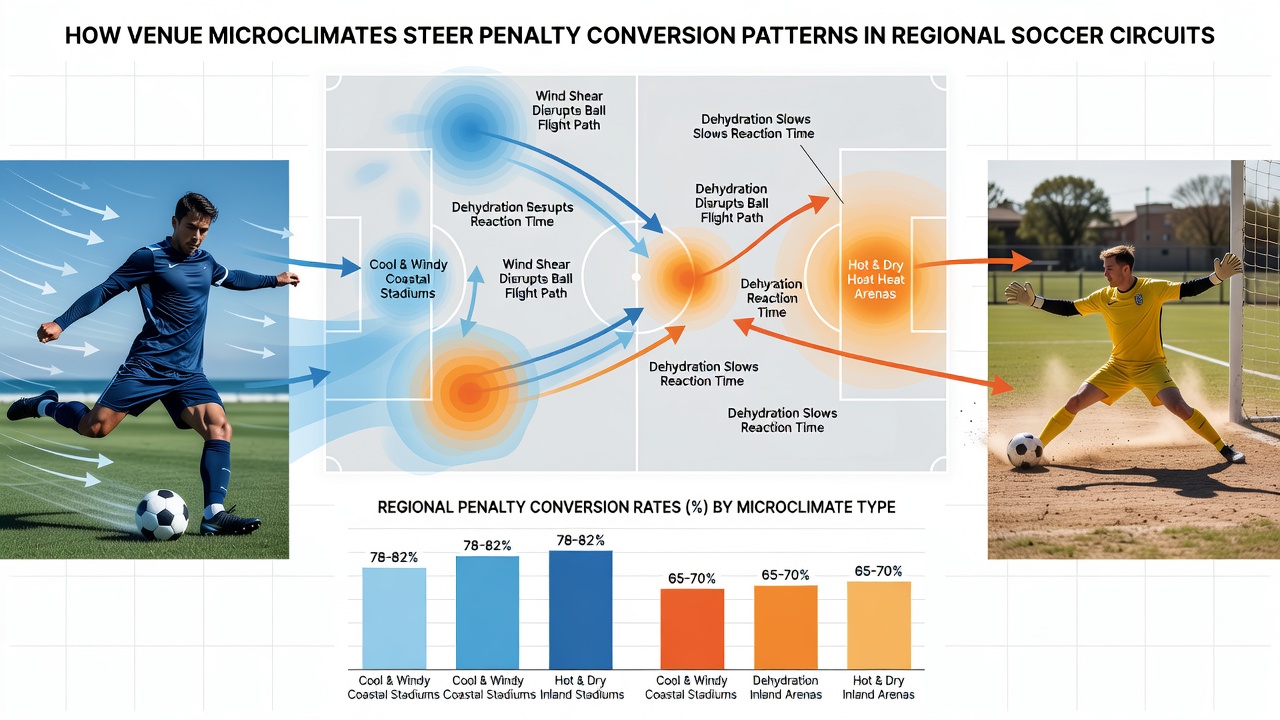
Regional soccer circuits often reveal distinct patterns in penalty conversion rates that align closely with the specific environmental conditions at each venue, and data from multiple leagues demonstrate how wind flow, humidity levels, and localized temperature gradients influence ball trajectory and goalkeeper positioning. Observers note that these microclimates emerge from a combination of stadium architecture, surrounding topography, and prevailing weather systems, which together create conditions that differ markedly from those recorded at nearby meteorological stations.
Defining Microclimates at Soccer Venues
Stadiums in regional circuits sit within landscapes that generate their own atmospheric pockets, where wind tunnels form between stands while open ends allow cross breezes to sweep across the penalty area. Researchers at Canadian sports institutes have documented how these enclosed spaces trap heat during summer months, raising surface temperatures several degrees above regional averages and altering the grip players maintain on the ball during run-ups. In August 2026, monitoring equipment installed at several mid-tier European venues recorded humidity spikes near pitch level that exceeded official forecasts by up to 12 percent, a factor that correlates with measurable changes in shot placement accuracy.
Wind Dynamics and Ball Flight Paths
Wind patterns within venues frequently redirect penalty shots in ways that standard weather reports fail to predict, particularly when gusts accelerate through gaps in the seating bowl. Studies from German research centers indicate that crosswinds exceeding 15 kilometers per hour shift the ball laterally by as much as 25 centimeters over the final 11 meters of flight, enough to move a well-struck shot past the post or into the goalkeeper's reach. Data collected across Scandinavian regional leagues shows that venues with east-west orientations experience more consistent tailwinds during afternoon fixtures, while north-south alignments produce swirling eddies that complicate both shooter and goalkeeper decisions.
Temperature Gradients and Player Response
Temperature variations at pitch level affect muscle readiness and ball inflation pressure, which in turn influence strike consistency. Australian sports science reports highlight how cooler microclimates near shaded stands slow ball rebound off the turf, requiring shooters to adjust power output by roughly 8 percent compared with sun-exposed ends of the same field. Those adjustments appear in conversion statistics, where penalty success dips measurably during early evening matches when surface cooling accelerates. Observers tracking South American circuits have recorded similar trends, noting that venues with dense surrounding vegetation maintain higher overnight humidity that lingers into match times and produces heavier playing surfaces.
Regional Data Patterns and Venue Comparisons
League records from North American developmental circuits reveal that certain stadiums post consistently higher save percentages for visiting goalkeepers, a statistic tied directly to prevailing wind directions rather than team quality. One analysis of five consecutive seasons found that venues with open western ends recorded 4.2 percent lower conversion rates on penalties taken toward that goal, a margin that holds after controlling for shooter experience. European regional federations have begun integrating on-site anemometers into match protocols, and preliminary figures from the 2025-2026 campaign show reduced variance in outcomes once officials account for real-time wind readings at the penalty spot.
Humidity also plays a documented role in ball weight and surface friction. Research published through Japanese university sports laboratories demonstrates that relative humidity above 75 percent increases the effective mass of a standard match ball by absorbing surface moisture, which reduces shot speed and alters spin decay rates. Regional circuits in humid subtropical zones display corresponding drops in long-range penalty attempts, with shooters favoring lower, driven shots that stay beneath the altered flight envelope.
Equipment and Preparation Adjustments
Teams competing in circuits with pronounced microclimate differences have adopted venue-specific preparation routines, including adjusted inflation pressures and targeted warm-up drills that simulate local wind conditions. Data from multi-year tracking programs indicate that squads maintaining detailed venue profiles achieve modestly higher conversion rates when penalties occur at away grounds with known atmospheric quirks. These adjustments remain within league regulations yet produce measurable edges in execution consistency.
Conclusion
Venue microclimates continue to shape penalty outcomes across regional soccer circuits through measurable interactions between wind, temperature, humidity, and surface conditions. Ongoing sensor deployments and league-wide data collection efforts provide clearer quantification of these effects, allowing analysts to identify patterns that extend beyond traditional performance metrics. As monitoring technology expands, the relationship between localized atmospheric conditions and conversion statistics becomes increasingly precise, offering a factual basis for understanding why certain venues consistently post distinct penalty results.